描述
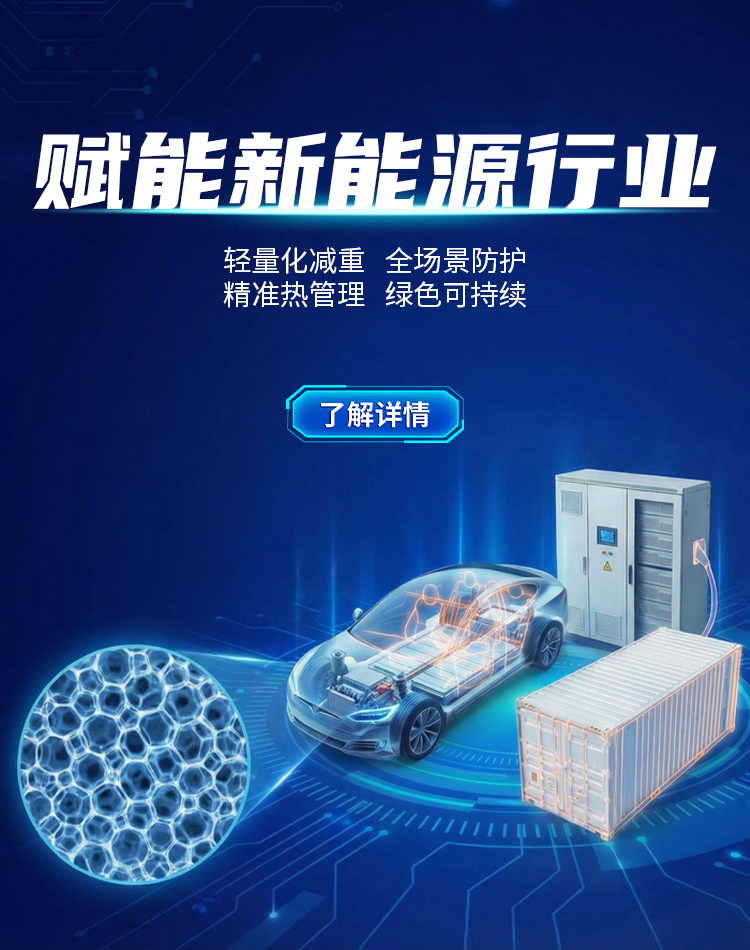
Adapt product system to new energy scenarios
Detailed explanation of key application scenarios
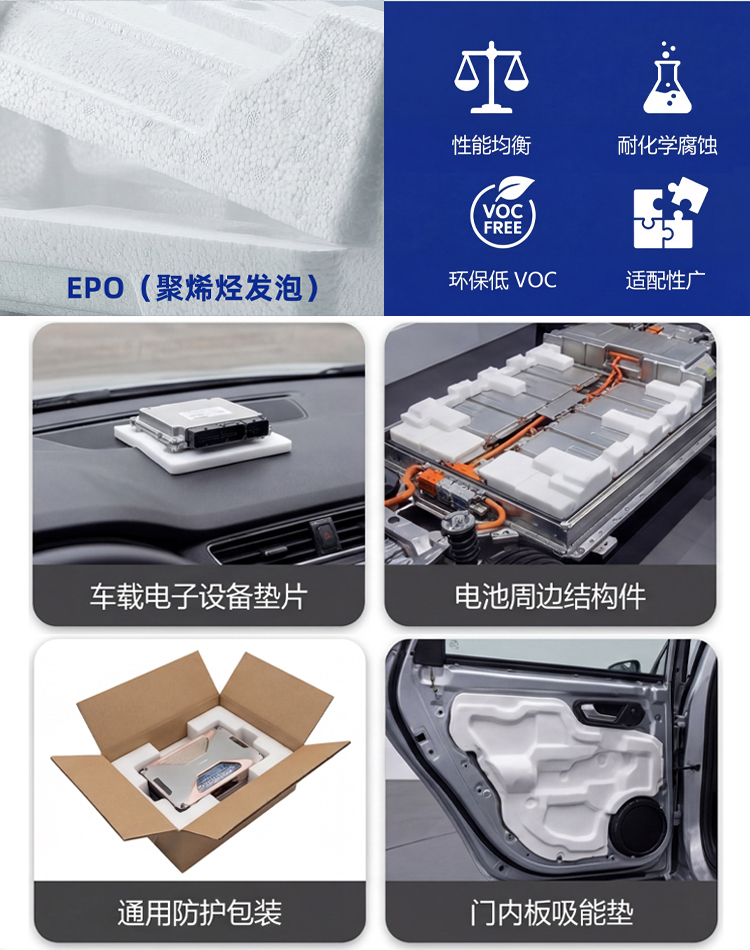
  • Buffer/insulation between battery cells
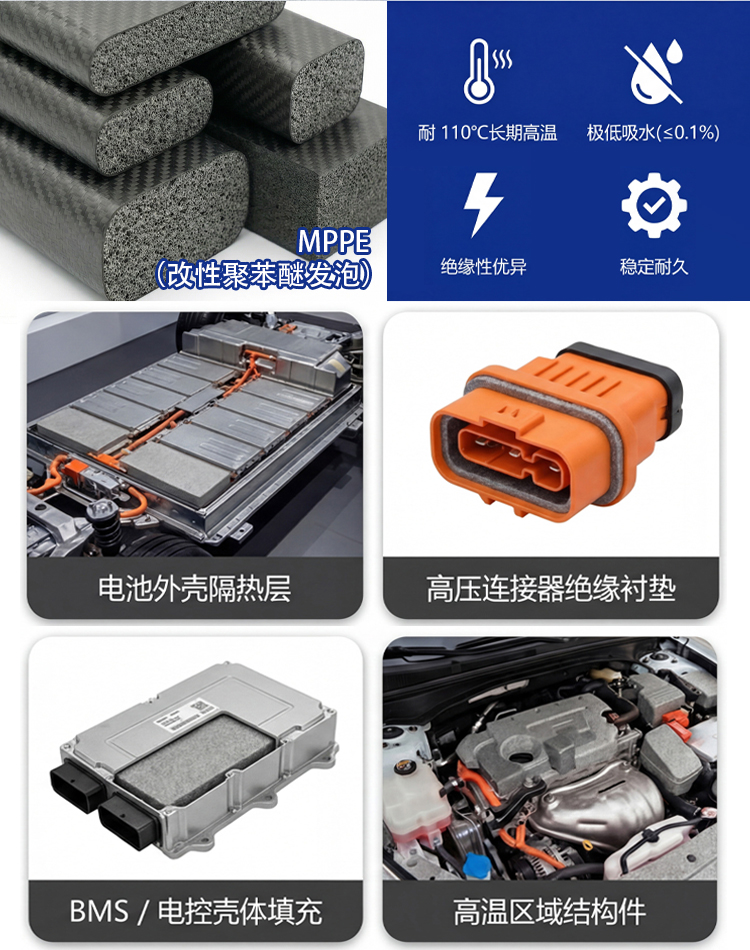
    a. Material selection: EPP (density 30-50 kg/m³)+ MPPE (density 40-60 kg/m³) composite application b. Core role: Special foam parts for filling cell spacing not only absorb vibration and impact during driving through the high rebound characteristics of EPP and avoid cell collision damage; and also use MPPE's low thermal conductivity (≤0.038 W/(m·K)) to form a high-efficiency thermal isolation layer. When a single cell is thermally out of control, it can delay the heat spread rate for ≥60 seconds, leaving sufficient time for the vehicle's thermal management system to respond and personnel escape. c. Adaptation scenarios: square/cylindrical/soft-pack battery cell modules, power battery pack inner core layers
  • Battery module/box support and protection
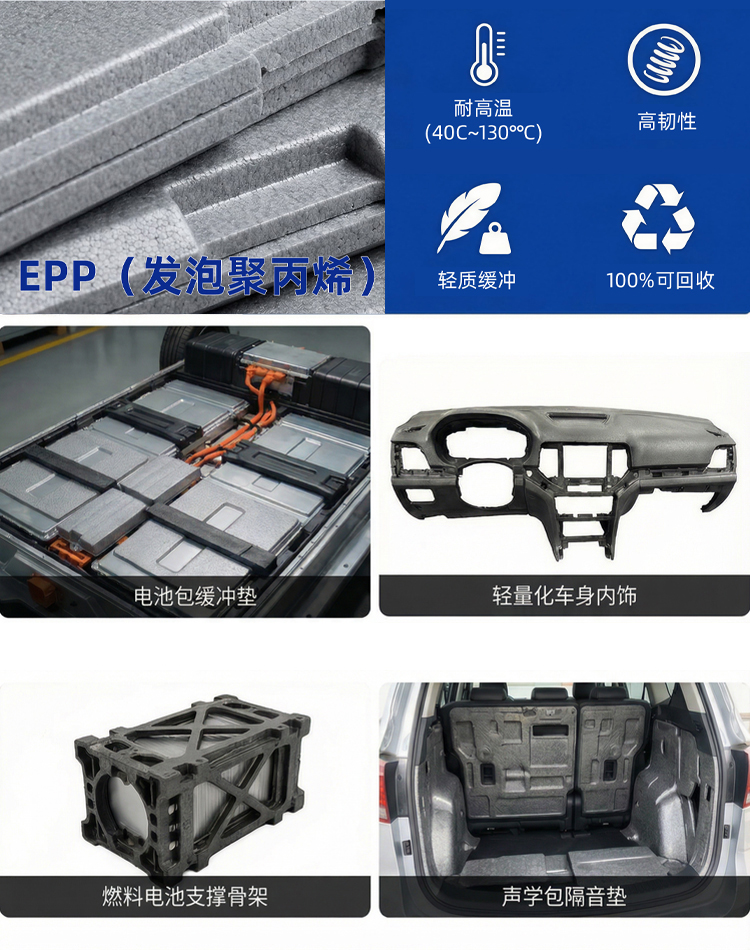
    a. Material selection: high-strength EPP (compressive strength ≥0.3 MPa) b. Core role: Custom-molded EPP structural parts replace traditional metal/plastic supports. While providing stable mechanical support (can withstand the weight of the battery module ≥500kg without deformation), it achieves a weight reduction of 15%~30%, calculated based on the weight of the new energy vehicle battery pack of approximately 300kg, it can directly reduce the weight of 45-90kg, helping to increase the cruising range by 5%-8%. c. Added value: Anti-collision buffer ribs are designed on the edges of the structural parts. Combined with the energy absorbing characteristics of EPP, they can absorb more than 80% of the lateral impact energy and reduce the risk of deformation of the battery box. d. Adapt scenarios: battery module bottom support, box circumferential side protection, battery pack upper and lower covers filling
  • Insulation protection of high-voltage components
    a. Material selection: MPPE foam material (dielectric strength ≥20 kV/mm) b. Core role: Insulating gaskets and sheaths used for high-voltage connectors, busbars, fuses and other components maintain excellent insulation properties over a wide temperature range of-40 ℃ to 110℃, and have extremely low water absorption (≤0.1%). Avoid insulation failure in humid environments and ensure long-term safe operation of high-voltage systems (voltage ≥ 300V). c. Process advantages: Support precision molding, can fit the contours of complex parts, achieve "seamless insulation packaging", and increase assembly efficiency by 40%. d. Adaptation scenarios: high-voltage distribution box, BMS sampling line, battery pack high-voltage interface
As the core power source of new energy vehicles, the power battery system has strict requirements for buffering, heat insulation, insulation, and lightweight. Jiasheng builds a full-dimensional safety protection system through precise material selection and structural customization.
(1) Power battery system (core safety scenario)
  • ECU/BMS housing filling and protection
    a. Material selection: MPPE/EPO composite material (MPPE accounts for 60%+EPO accounts for 40%) b. Core role: The interior of the shell is filled with customized foam parts. On the one hand, the high-temperature conduction of the engine compartment is isolated through the high-temperature resistance characteristics of MPPE (long-term resistance to 110℃) to avoid the degradation of electronic components due to overheating; on the other hand, the cushioning performance of EP0 absorbs driving vibration (can attenuate vibration with a frequency of 5-2000Hz) and reduces the risk of component solder joints falling off. c. Added value: The material has a certain electromagnetic shielding auxiliary effect (shielding efficiency ≥15dB), which can reduce the impact of external electromagnetic interference on the electronic control signal; at the same time, it complies with the low V0C standard (V0C release ≤100μgC/g), and is free of harmful substances such as benzene and aldehyde to ensure the air quality inside the vehicle. d. Adaptation scenarios: Vehicle Controller (VCU), Battery Management System (BMS), Motor Controller (MCU)
  • Sensor/Controller Packaging and Transportation
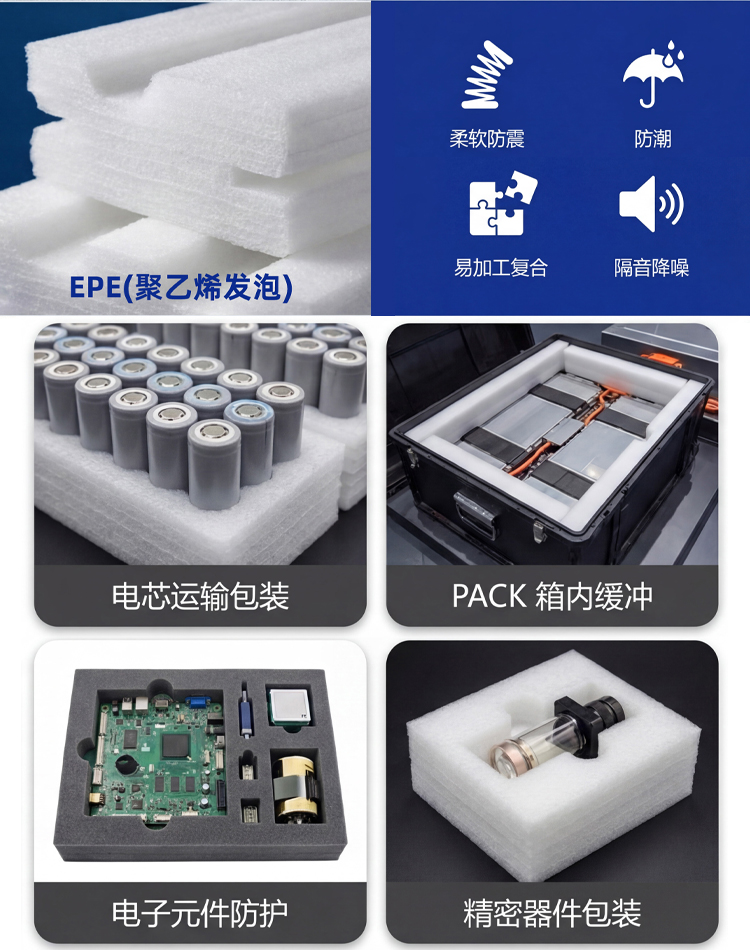
    a. Material selection: EPE composite pearl cotton (thickness 5-20mm, density can be customized) b. Core role: The custom-molded inner support accurately fits the outline of the device. Through the soft and shockproof characteristics of EPE (rebound rate ≥90%), it resists impact during transportation and assembly (can withstand a 1.5m drop without damage), and at the same time has moisture-proof, anti-scratch function to avoid surface wear of precision components (such as laser radar, temperature sensors) or damage to internal components. C. Process advantages: It can be combined with aluminum foil and non-woven fabrics to enhance heat insulation and antistatic properties and adapt to the special needs of different electronic components. d. Adapted scenarios: autonomous driving sensor, battery temperature/voltage sensor, charging gun controller
In-vehicle electronic components (ECU/BMS/sensors, etc.) have extremely high requirements for vibration resistance, heat insulation, and interference prevention. Jiasheng uses customized foaming solutions to ensure stable operation of components under complex working conditions:
(2) Vehicle electronic and electronic control systems (precision protection scenarios))
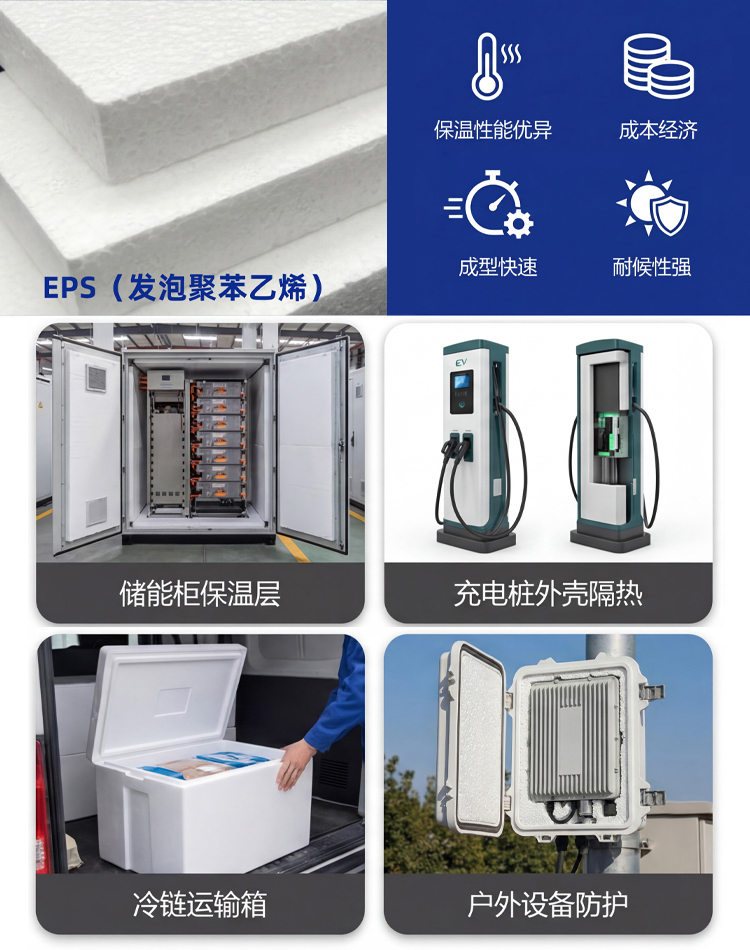
  • Energy storage cabinet insulation and thermal management
    a. Material selection: EPS foam board (density 25 - 30 kg/m ³)+ EPP seals b. Core role: EPS insulation layer (thermal conductivity ≤ 0.039 W/(m·K)) is laid on the inner wall of the energy storage cabinet, which can effectively maintain the temperature inside the cabinet stable at the optimal working range of 15 - 35 ° C and reduce air conditioning refrigeration/Heating energy consumption and improve the energy efficiency of the energy storage system by ≥ 10%; EPP seals are used in cabinet doors, connection ports and other parts, which not only enhance the insulation effect, but also have waterproof and dustproof functions (protection levels can reach IP54). c. Weathering advantages: EPS is added with anti-ultraviolet additives, and there is no obvious aging or cracking after 5 years of outdoor use; EPP seals have strong weather resistance, and the elastic retention rate is ≥ 85% under-30 ℃~70 ℃. d. Adaptation scenarios: household energy storage cabinets, industrial and commercial energy storage containers, energy storage power station battery compartments
  • Charging pile insulation/protection and structural support
    a. Material selection: EPS insulation layer + EPP structural parts b. Core role: EPS heat insulation layer is laid inside the charging pile shell, which can block the internal high temperature caused by direct sunlight in summer (reduce the internal temperature by 10 - 15 ℃) and prevent the charging module from triggering protective shutdown due to overheating; internal core components (such as the main control board, charging module) are fixed with EPP structural parts, which not only achieves weight reduction (20% weight reduction), but also resists external impact through the energy-absorbing characteristics of EPP and protects internal components. c. Added value: The flame retardant rating of the material can reach UL94V-0, and will not spread in case of fire, meeting the fire safety requirements of charging piles; the weather resistance is suitable for outdoor environments of-30 ℃~60 ℃, and can be used for a long time without additional protection. d. Adaptation scenarios: AC charging pile, DC fast charging pile, power station charging interface
Energy storage cabinets, charging piles and other equipment have been exposed outdoors for a long time and need to deal with complex environments such as temperature fluctuations, rain and snow erosion, and ultraviolet radiation. Jiasheng Foam Materials provides dual solutions for insulation and protection:
(3) Energy storage and charging infrastructure (outdoor weather-resistant scenarios)
  • Lightweight interior parts for body
    a. Material selection: EPP foam material (density 20 - 40 kg/m ³) b. Core role: Replace traditional plastic and sponge parts and are used for headrest cores, door panels, seat backs, roof linings, etc., reducing the weight of individual components by 30%-50%(for example, headrest core materials from 0.8kg to 0.4kg), the cumulative weight loss of the entire vehicle interior is 5 - 10 kg, indirectly improving the cruising range. c. Comfort advantages: EPP has good breathability and elasticity, the seat core material can fit the curve according to ergonomically designed, and the headrest core material has excellent shock absorption effect, reducing long-distance driving fatigue; at the same time, it has no odor, low VOC, and conforms to the vehicle. Environmental protection standards. d. Adaptation scenarios: new energy passenger car/commercial vehicle interiors, fuel cell car seats
  • NVH Acoustic Package Material Applications
    a. Material selection: EPE/EPP composite layer (EPE thickness 10 - 15 mm + EPP thickness 5 - 10 mm) b. Core role: It is used for acoustic package components such as engine compartment sound insulation mats, chassis sound insulation layers, and door sound insulation panels. The soft characteristics of EPE can absorb medium and high frequency noise (2000 - 8000 Hz), and the dense structure of EPP can block low frequency noise (50 - 500 Hz). Under the synergy, it can reduce the noise inside the car by 3 - 8 dB and create a quiet driving space. c. Process advantages: It can be adapted to complex curved surfaces of the car body through hot pressing, molding and other processes, making it easy to assemble and not easy to fall off. d. Adaptation scenarios: engine compartment, chassis, doors, trunk of new energy passenger vehicles
Due to the reduction of motor noise, new energy vehicles have more prominent needs for sound insulation, shock absorption and lightweight body. Jiasheng achieves dual improvements in "weight reduction + comfort" through the application of foaming materials:
(4) Body weight reduction and NVH optimization (comfort experience scenario)
  • Long-haul land/air battery transfer box
    a. Material selection: high-strength EPP (density 40 - 60 kg/m ³)+ flame retardant EPS outer layer b. Core role: The EPP inner support accurately fits the battery outline and passes ISTA 3A certification. It can withstand a 1.8m drop without damage and absorbs more than 85% of the vibration energy during transportation; the flame-retardant EPS outer layer has heat and moisture insulation functions, maintaining structural stability at-30 ℃~60 ℃ c. Compliance advantages: Materials are 100% recyclable, meet UN38.3 transportation standards, and pass RoHS/REACH certification d. Adaptation scenarios: Bulk transportation of power battery modules, energy storage batteries PACK, and high-value batteries e. Product layout: Real shot view of the EPP battery transfer box (including internal buffer structure and drop test schematic)
  • Battery samples/precision components transport packaging
    a. Material selection: EPE composite aluminum foil + EPO buffer b. Core role: EPE's soft features avoid surface scratching, aluminum foil layer enhances heat insulation and moisture resistance, EPO structural parts provide precise support to meet the needs of small batch and multi-frequency transportation c. Process advantages: Can be customized with shaped structure, convenient assembly, and repeated use ≥ 50 times d. Adaptation scenarios: battery samples are submitted for inspection, precision battery components are transported across factories e. Product drawing: EPE + EPO battery sample transportation packaging disassembly drawing
  • Cold chain battery transportation incubator
    a. Material selection: high-density EPS (density 25 - 30 kg/m ³)+ EPP sealing strip b. Core role: Thermal conductivity ≤ 0.039 W/(m·K), can maintain the temperature in the box of 0 - 10 ℃ for 48 hours, suitable for low-temperature transportation needs of lithium batteries c. Added value: Lightweight design, 20% lighter than traditional incubators, reducing transportation costs d. Adapted scenarios: Transportation of power batteries and energy storage batteries with high temperature control requirements e. Product layout: EPS cold chain battery insulation box diagram
New energy battery transportation (including batteries, modules, and PACK) needs to meet the four core requirements of "anti-drop, anti-vibration, heat insulation and moisture, and environmental compliance". Jiasheng provides customized packaging solutions for different transportation scenarios (long-distance land transportation, air transportation, and cold chain transportation):
(5) New energy battery transportation packaging (new safety logistics scenarios)

Four core advantages
our performance pledge
Connect with professional teams immediately